
Application of Scraped Surface Heat Exchangers in the Margarine Industry
Scraped Surface Heat Exchangers (SSHE) are highly efficient heat transfer devices that enhance heat transfer through mechanical scraping. They are particularly suitable for high-viscosity, easily crystallizable or particulate-containing fluids. The following is an analysis of their working principle and specific applications in the margarine industry:
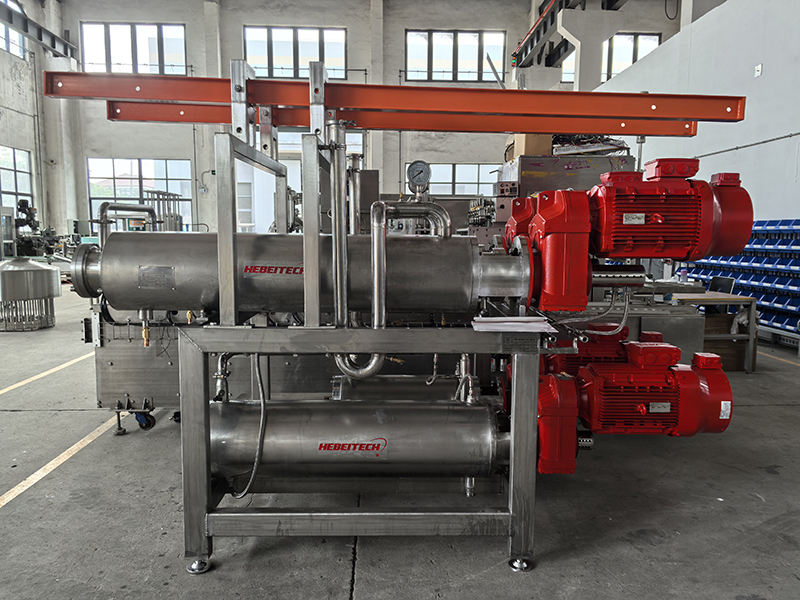
I. Working Principle of Scraped Surface Heat Exchangers
1. Core Structure
o Jacketed cylinder: The outer layer is supplied with heating/cooling media (such as steam, cold water or heat transfer oil).
o Rotating shaft and scraper: Inside, there is a rotatable shaft with multiple flexible or rigid scrapers attached, which closely adhere to the inner wall of the cylinder.
o Drive unit: A motor drives the shaft to rotate at high speed (typically 100-500 rpm).
2. Working Process
o Scraping effect: The scrapers continuously scrape the material off the inner wall, preventing fouling or crystallization, and simultaneously force the renewal of the boundary layer on the heat transfer surface, significantly increasing the heat transfer coefficient (up to 5-10 times that of traditional tube heat exchangers).
o Mixing function: The rotating scrapers exert shearing and stirring effects on the material, promoting uniform temperature and composition.
o Phase change control: By precisely adjusting the jacket temperature and scraper speed, rapid cooling, crystallization or emulsification of the material can be achieved (such as controlling fat crystallization in margarine).
3. Advantages and Characteristics
o Suitable for high-viscosity (up to 10^5 cP), non-Newtonian fluids or materials containing solid particles.
o Avoids local overheating or cold spots, ensuring uniform product quality.
o Can handle sensitive materials prone to coking or crystallization.
II. Application in Margarine Production
1. Key Role in the Production Process
The production of margarine requires the emulsification of oils and water phases (milk, salt, emulsifiers, etc.) followed by rapid cooling and crystallization. The scraped surface heat exchanger is a core device, mainly applied in:
o Cooling and crystallization of emulsions: Rapidly cooling the mixed emulsion (about 40-50°C) to 10-20°C to induce the formation of stable β' crystal structure (crucial for a smooth texture).
o Nucleation processing: The shear force of the scrapers breaks down large crystals, forming a fine and uniform fat network, enhancing the cream's extensibility.
o Sterilization treatment: In some processes, high-temperature jackets are used for short-term sterilization (e.g., 85°C for 15 seconds).
2. Industry Adaptability
o Precise temperature control: Fat crystallization is temperature-sensitive (e.g., palm oil needs to be controlled at 20-25°C), and the scraped heat exchanger can precisely maintain the temperature range.
o Prevention of phase separation: High shear force ensures uniform dispersion of the water phase, avoiding oil-water separation.
o Handling high-fat materials: Margarine contains 70-80% fat, and the scraper design overcomes the clogging problem of traditional heat exchangers.
3. Typical Equipment Parameters
o Heat transfer coefficient: 500-1500 W/(m²·K) (depending on the viscosity of the material).
o Cooling rate: Up to 30°C/minute (critical for fat crystallization kinetics).
o Capacity: Industrial-scale equipment can handle 1-10 tons per hour.
III. Comparison with Other Heat Exchangers
Applicability in margarine ★★★★★ ★★☆ ★☆☆
| Characteristics | Scraped Surface Heat Exchanger | Shell and Tube Heat Exchanger | Plate Heat Exchanger |
| Applicable viscosity | High (≤10^5 cP) | Moderate-low (≤10^3 cP) | Low (≤10^2 cP) |
| Fouling risk | Very low (self-cleaning by scraping) | High | Moderate |
| Shearing effect | Strong (controllable) | Weak | Weak |
IV. Industry Development Trends
• Energy optimization: Use variable frequency motors to adjust scraper speed, matching different formula requirements (e.g., higher shear for low-fat cream).
• Intelligent control: Integrate temperature-viscosity sensors to adjust cooling rate and shear force in real time. • Sanitary design: Compliant with EHEDG/3A standards, the CIP (Clean-In-Place) system reduces downtime.
The scraper heat exchanger, with its highly efficient heat transfer and mixing capabilities, has become an indispensable key equipment in the margarine industry. Especially under the trend of pursuing low trans-fat and high-functional products, its precise processing advantages will be further highlighted.
Post time: Jul-02-2025